
Happy Birthday Duke! is a concert and show that you really should see. It's a concert that celebrates Duke Ellingtons 110th birthday. The concert features no less than three bands and orchestras: Uppsala University Jazz Orchestra, SweDukes and the Middlesex group.
But wait there's more. Way more. You will also see the swing dance troupe MessAround perform together with the bands. The will show off all kinds of swing dances: Lindy hop, balboa, shag, charleston and tap.
The concert takes place next Wednesday, April 29th, at Univeritetsaulan, at 19.30.
Tickets cost 130 kr (90 kr for students). If you got a UNT-card: 100 kr (70 kr for students). Buy tickets via UNT Biljett (018-478 10 70) or at Ticnet.
Invite all your friends to Happy Birthday Duke! on Facebook.
If you were at Cats Corner yesterday, you got a sneek peak of MessAround doing the charleston number Uppsala Stomp. The number was tight and had lots of energy.
Uppsala University Jazz Orchestra (UUJO) has got a new member: Claes Brodda on saxophone. The photo above is from Saturday when he played together with Jennie Löbel and the Swing Kings at Swingkattens dance at Grand. I look forward to hear more of him. (I'll post more about the Saturday night dance later).
The photos are taken by me and may not be published elsewhere without my permission. Contact me if you want to buy or license them.
Will you attend "Happy Birthday Duke!"? Please comment.
Wednesday, April 22, 2009
Happy Birthday Duke! - Concert and show April 29th


Thursday, April 16, 2009
1920s Charleston at the Gatsby Picnic 08 - Lynne and Peter
I really like this video clip from the Gatsby Picnic 2008 where Lynne Koehlinger and Peter Varshavsky perform a 1920's partner charleston routine to Jimmie Noone's Apex Orchestra song "Every Evening (I Miss You)".
The charleston dancing looks very airy and light and there is all sorts of charleston in the routine; partner charleston, solo charleston and breakaways (that later on developed into lindy hop swingouts). I'd like to get better at charleston, it's been a while since we had charleston workshop in town.
What do you think of the video clip? Please comment.
Thursday, January 22, 2009
The Great Gatsby - Charleston dancing
Here is a fun video clip from the film The Great Gatsby where people are dancing Charleston at a wild party and jumping into the fountain.
I would have liked to been at that party in the roaring 20's!
The film The Great Gatsby is from 1974 and has Robert Redford and Mia Farrow in the leading roles.
I think this might be where the director for the music video of Come To Me by Koop got some of his ideas.
What do you think of the video clip with charleston dancing from The Great Gatsby? Please comment.
Thursday, January 15, 2009
Jail House Blues - Hal and Honey Abbott
Here is a comedic dance routine by Hal Abbott and Honey Abbott from the short film "Woody Herman and His Orchestra" from 1938.
Mostly they dance shag but they also do tap dancing and some charleston kicks. I'm not sure but they could also be dancing Peabody (1:14-1:24), can anybody set me straight?
I think that the solo footwork that Hal Abbott does in the very last seconds of the video clip is really amazing. Wow.
Can anyone tell me more about Hal and Honey Abbott?
What do you think of Hal and Honey Abbott dancing to Jail House Blues? Please comment.
Saturday, December 27, 2008
White Christmas: Vera-Ellen
I'm continuing on the Christmas theme: Take a look at this video clip from the movie White Christmas where Vera-Ellen dances with John Brascia.
You'll see jazz steps and even a hand-to-hand charleston move.
Last year I posted another clip from White Christmas: The Best Things Happen While You're Dancing.
What do you think of the video clip from White Christmas? Please comment.
Wednesday, November 19, 2008
Charleston dancing in Europe in the 1920's
Charleston became a dance craze in the 1920's and traveled over to Europe as well. Above is a video clip from 1929 with a British band and some dancers dancing Charleston.
If you are interested in old footage from the 1920's and 1930's, you should check out the YouTube profile for jozefsterkens, who posted the clip above. He has posted over 700 other video clips.
You can find out more about dance history at http://dancehistory.org/
What do you think of the video clip with Charleston dancing? Please comment.
Sunday, September 21, 2008
Enoch Light & The Light Brigade: Charleston
Here is a version of the song Charleston performed by Enoch Light & The Light Brigade from the album Big Hits of the 20s from 1971.
Enoch Light was one of the first musicians to really take advantage of stereo recording. He recorded all kinds of music but to me the most interesting music is his recordings of songs written in the 1920s-1940s.
Some of his other recordings are *cough* a bit obscure. Just listen to "I want to be happy cha cha", its very far from how the young Ella Fitzgerald sung it.
Take a look at this site to learn more about Enoch Light.
What do you think about the version of Charleston by Enoch Light? Please comment.
Saturday, August 2, 2008
Canal Street Syncopators: Rooftop concert

Tonight the band Canal Street Syncopators will play on a rooftop concert at Kulturhuset in Stockholm, that's smack dab in the middle of Stockholm by Sergels torg. Canal Street Syncopators is a great orchestra, you should see them if you have the opportunity .
At 18 there will be a taster lesson in how to dance charleston taught by Fatima Teffahi from the Harlem Hot Shots. The Canal Street Syncopators will play from 19-22 then The Rhythm Sweethearts will dj until midnight. There will be a dance show by the Midnight Rounders (does anyone know anything about that group?). Tickets cost 150 kr.
The photos are taken by me and may not be published elsewhere without my permission. Contact me if you want to license them.
What do you think of the Canal Street Syncopators? Please comment.
Tuesday, October 23, 2007
Ginger Rogers dances Charleston in Roxie Hart
Ginger Rogers was quite a Charleston dancer, in fact that was how she started her career as a dancer and actress. Here is a scene from the film Roxie Hart (1942) where Ginger Rogers dances Charleston. The scene did however not make into Roxie Hart, maybe it was the production code for the movie industry that put a stop to that, I don't know.
The story is based on a true crime and has been made first into a silent movie: Chicago (1927) and of course the modern day remake: Chicago (2002) featuring Renée Zellweger as Roxie Hart.
What do you think of Ginger Rogers dancing Charleston in Roxie Hart? Tell me.
Sunday, September 9, 2007
1920's Partnered Charleston: Dan Guest & Jessica Lennartsson
Charleston is a dance that can be danced both with and without a partner. Here is a wonderful video clip with Dan Guest & Jessica Lennartsson who dances charleston in this fun dance routine. A lot of humor and moves that match the music.
The music is Black Bottom by Spike Jones. Crazy tune. Crazy like only Spike Jones can be.
I found out about this clip thanks to Hans who also told me about the Hellzapoppin routine done to Jumpin At The Woodside before.
What do you think of the 1920's charleston routine by Dan Guest & Jessica Lennartsson? Tell me.
Thursday, August 2, 2007
Brigitte Bardot sings Les amis de la musique
Who would have expected to see a video clip with Brigitte Bardot singing a hot jazz song? Take a look at her singing "Les amis de la musique" where she also dance some charleston. Quite charming.
Do anyone know where this video clip with Brigitte Bardot is from? Tell me if you know anything more about it.
What did you think of Brigitte Bardot singing "Les amis de la musique"? Tell me.
Wednesday, July 11, 2007
Diga diga doo by Firecracker Jazz Band
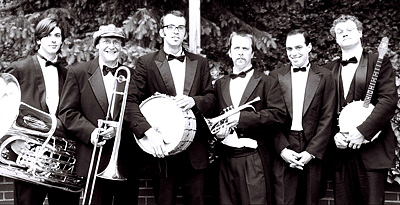 I'm always looking for new versions of great songs, now I've found terrific hot jazz version of Diga diga doo by the Firecracker Jazz Band from Asheville, North Carolina. One of the best versions I've heard. Listen to Diga diga doo.
If I lived in Asheville I would definitely go out and see them perform, why don't you take a look at their MySpace page to see where they are playing next? I would love to have their cd.
There's a lot of good things in Asheville right now. Like Sugar Foot Stomp, an "old-fashioned fast-dance and hot-jazz" dance weekend that coming up July 13th-15th. They will have workshops taught by Chad Fasca and Midori Asakura Fasca who will teach dances like charleston and peabody. And of course a lot of hot jazz music.
Check out this video clip with Chad and Midori from the 2004 American Lindy Hop Championships where they won the Fast Dance division dancing a combination of peabody and charleston.
What do you think of the Firecracker Jazz Band? Tell me.
Sunday, May 13, 2007
Koop: Come to me feat. Harlem Hot Shots
When you dj, you are often looking for songs that will create a certain feeling or mood on the dance floor. You try to find songs that match that feeling or will lead you along a path towards that mood.
Today it's Sunday, so I'm trying to come up with a blog post that gives you a relaxed Sunday morning feeling. Here is a song that is softly swinging that may get you up from your bed. Come to me by Koop.
This music video for the song "Come to me" by Koop is directed by Marcus Söderlund and was shot at the Beatelund mansion at Ingarö outside of Stockholm Aug 1-2 2006. The song is from their album "Koop Islands"
In this video you can spot several members of the swing dance show group The Harlem Hot Shots doing lindy hop and charleston.
This seems to be a great place to have a party. Location and decoration is important to me when I throw a party. Good music and great people are the most important things but it has to look great as well. Small details can really make a difference.
What do think of this video clip with Koop performing Come To Me? Were you an extra at the video shoot? What was that like? Tell me.
Monday, April 23, 2007
Phontrattarne: Grand Show preview
Phontrattarne is one of Uppsalas best big bands. On Saturday they held a concert at Stora Torget in Uppsala and gave a preview of what they will perform at their Grand Show at Reginateatern between 10th and 17th of May.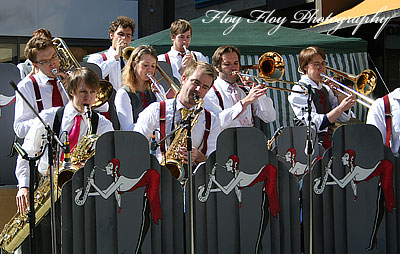
The shows are usually great fun for any swing music lover, this band know how to entertain and have a lot of good singers.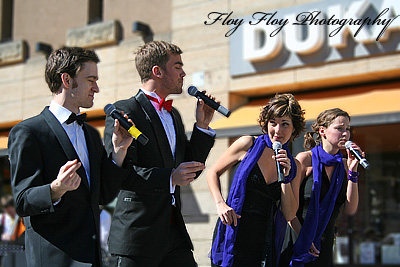
They showed new number based on the song "The Charleston". A fun choreography with all the charleston moves and of course a lot of cute dancers.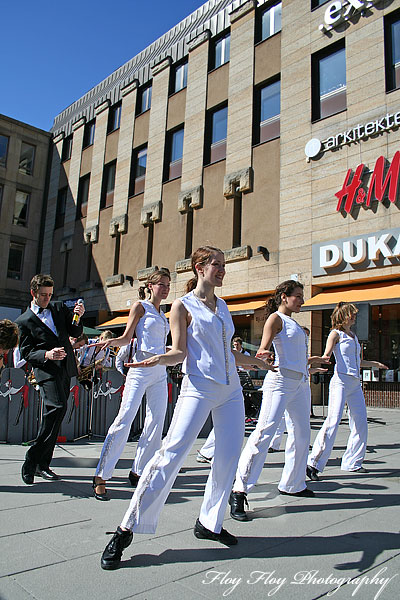
Phontrattarnes Grand Show is a must see. Make sure to see it in May. The photos are taken by me and may not be used elsewhere without my permission.
Are you planning on see Grand Show at Reginateatern? Tell me.
Tuesday, March 20, 2007
Ulf Carling: Swing dj at Dekadans tonight
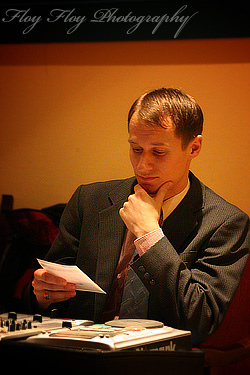 Tonight Ulf Carling will be the swing dj at Dekadans. Come there and dance to the swing music.
Tonight is a also Beginners Night where we try to get as many people there from the beginners courses and get them to have fun dancing socially.
During one hour in the beginning of the evening all experienced dancers dance only with beginners and get to know them.
I think this is a important thing to do, when you start dancing you are easily intimidated by experienced dancers. You think that they are too good to ask to dance because they will get bored because you don't know much stuff.
As an experienced dancer I can tell you that that is not the case as long as you are smiling and you're trying your best. We want you do become a better dancer but we know that it takes time. Knowing this, it might be easier to ask someone to dance, it's still a little bit intimidating, but you must be brave.
I always try to dance with two or three persons a night that I haven't danced with before. It's fun to get to know new people.
Now, a little bit more about Ulf Carling. Ulf is also a drummer in the Carling Family band. He always adds a good portion of humour when he plays drums. All his family is talented musicians, the most well known relative is his sister Gunhild Carling. Tonight at Dekadans, I hope he plays a private recording of One Oclock Jump from when Gunhild played with the Count Basie Orchestra. I really would like to have that recording myself because it's really great!
As a bonus I've found a old video clip from 1990 with Carling Hot Six playing "You're Driving me Crazy" with Ulf at the drums and his sisters doing a charleston dance routine.
The photo of Ulf Carling was taken by me and may not be used elsewhere without my permission.
Have you heard Ulf Carling play drums or dj? Tell me.
Saturday, March 3, 2007
Satan in the Dance Hall: Social Dancing and Morality in 1920s New York

This is the fifth part of an interview with Ralph G. Giordano who recently published his book Social Dancing in America: A History and Reference Volume 2 Lindy Hop to Hip Hop, 1901-2000.
[Part 1: How come you wrote a book about social dancing in America?]
[Part 2: Which dances do you write about in the book? ]
[Part 3: Can you share some interesting facts about Lindy hop?]
[Part 4: Do you include Balboa in the book?]
Part 5: Tell me about the next book you're writing
My next book “Satan in the Dance Hall: Social Dancing and Morality in 1920s New York” is as an interdisciplinary study of how the social, political, economic, and cultural events were intertwined with social dancing in New York City throughout the 1920s.
Arguably, no other period throughout American History is so closely identified with the freewheeling spirit of music and dancing, as did Prohibition, Jazz, dancing the Charleston, as did the 1920s. The perpetual image of the Charleston dance, Jazz music, flapper fashion, and flaunting prohibition is an indelible part of not only popular American history textbooks but also of folklore, legend, and especially Hollywood movies. However, what is lost to popular history is the fact that the 1920s were most likely the most morally disruptive period in American history, especially upon social dancing.
Americans were vehemently divided over Prohibition as many simply scoffed at the law and continued to drink and others proclaimed morality must be enforced by prosecution. Prior to Prohibition, many individuals drank at a neighborhood salon. During Prohibition, the saloons were closed and an “illegal” replacement called “speakeasies” emerged not only for drinking but also music, entertainment, and social dancing. Within cities such as New York, the speakeasy became a fashionable nightspot and newspapers heralded in the antics. To many supporters of Prohibitions, however, the speakeasies were viewed not only as contemptible lawbreakers but also as contributing to moral decadence.
Moral decadence was not only contained to the subject of alcohol. Throughout the country, Americans were continually besieged by a raging nationwide furor and debate between Fundamentalists and Modernists. Some of the most publicized issues included the nationwide push for Americanization, immigration quotas, eugenics, tabloid sensationalism, radio, mass produced automobiles, postal censorship, Hollywood movies, promiscuity, birth control, and the heavily publicized debate between evolution and creation culminating in the Scopes Monkey Trial. In the midst of all of the public and media attention, an almost innocent unwitting victim of the debate was social dancing.
The social dancing debate in New York City also paralleled the tenure of the Reverend John Roach Straton. In 1918, Straton assumed the pulpit at Calvary Baptist Church on West Fifty Seventh Street in New York. His condemnation certainly included all of the aforementioned nationwide issues, but some were specifically applied to New York City, which he viewed as “a modern Babylon.” Straton’s objections included card playing, jazz music, the Broadway theater, divorce, low-cut dresses, romance novels, the Museum of Natural History, boxing, nude art, anti-Catholicism, and even poodle dogs.
But his most ravage attacks were against social dancing and New York’s commercial dance halls. In an interview in the Brooklyn Daily Eagle on March 26, 1922, Straton’s response to the commercial dance halls echoed with fire and brimstone. He bellowed:
“the very fires of Hell are raging at them in the slums, the [dance] palaces and amusement centers of the city and when multitudes of young men and young women are being swept away to eternal destruction.”
At the time, Straton’s exploits were well chronicled in all of New York City’s eleven major daily newspapers. Stanley Walker, for example, city editor of The New York Herald Tribune noted:
“Straton came out in favor of legislation which would prohibit all public dancing except the more seemly sort of mazurkas, such as were danced by David and other pious hoofers in the olden times. Indeed, he was opposed to virtually everything in the way of amusement that was going on in New York”.
What do you think of this upcoming book? Tell me.
Friday, January 19, 2007
Excerpts from Social Dancing in America
This is the third part of an interview with Ralph G. Giordano who recently published his book Social Dancing in America: A History and Reference Volume 2 Lindy Hop to Hip Hop, 1901-2000.
[Part 1: How come you wrote a book about social dancing in America?]
[Part 2: Which dances do you write about in the book? ]
Part 3: Can you share some interesting facts about Lindy hop?
I can give you some excerpts from the book:
"Most Americans only saw the Lindy Hop in newsreels of the Harvest Moon Ball competitions and movies such as A Day at the Races (1937), Buck Privates (1941), Hellzapoppin’ (1941), Ride ‘Em Cowboy (1942), Groovie Movie (1944) a nine-minute movie short, and Killer Diller (1948). Each provides some of the best acrobatic performance and smooth style versions of the dance ever filmed.
The acrobatic aerial dance movements were eye-catching stellar performances by the best professional Lindy Hop dancers in the country. They were extremely fast paced and choreographed for maximum effect on the movie scene and definitely not for simple enjoyment on a social dance floor."
"The comedy A Day at the Races, starring the Marx Brothers did well at the box office. At the time, the Marx Brothers were one of the top Hollywood box office attractions. Scenes in the movie offer an excellent contemporary singer Alan Jones singing in the "crooning" style made popular by Bing Crosby. In various dance scenes Groucho Marx performs a Tango, Fox Trot, Rhumba, and Charleston.
The film also has an ensemble dance scene between Harpo Marx and some African American children and another scene of African Americans adults performing the Lindy Hop. Unfortunately a large segment of America did not get to see either the Harpo scene or the Lindy Hop scene. Since these scenes involved "racial mixing," they were censored out of distribution copies throughout the south and other areas of the United States. (At that time, this was a common practice of all Hollywood movies).
Copies with deleted scenes continued to air well into the 1970s on television stations. It was not until the very late 20th century that the movie was shown intact. By that time the age of the movie regulated it to specialty cable stations dedicated for movie buffs that regulated the segregation to obscure trivia status."
Wednesday, January 17, 2007
Social dancing in America: List of dances included in the book
This is the second part of an interview with Ralph G. Giordano who recently published his book Social Dancing in America: A History and Reference Volume 2 Lindy Hop to Hip Hop, 1901-2000.
[Part 1: How come you wrote a book about social dancing in America?]
Part 2: Which dances do you write about in the book?
Chapter 1: Animal Dances, The Castles, and Ragtime: 1901–1919
- Cakewalk, 1890 to 1900 (African American)
- Two-Step, 1890 to 1910 (American vernacular)
- Texas Tommy, 1901 to 1905 (African American)
- Ballin’ the Jack, 1901 to 1905 (African American)
- The Slow Drag, 1901 to 1905 (African American)
- Animal Dances: 1910 to 1920 (American vernacular)
Turkey Trot,
Chicken Scratch,
Monkey Glide,
Grizzly Bear,
Bunny Hug.
- Fox Trot, 1910 to 2000 (American vernacular)
- The One-Step, 1910 to 1920 (American vernacular)
- The Castle Walk, 1915 to 1920 (American vernacular)
- Hesitation Waltz, 1910 to 1920 (American vernacular)
- Apaché, 1910 to 1920 (Paris)
- Maxixe 1910 to 1920 (Brazil)
- Argentine Tango, 1905 to 1920 (South America / Caribbean.)
- Tango, 1905 to 1925 (South America / Caribbean.)
Chapter 2: The Charleston, Flappers, and Jazz: 1920 – 1932
- Black Bottom, 1919 to 1927 (African American)
- The Charleston, 1922 to 1929 (American vernacular and African American)
- Fox Trot, 1910 to 2000 (American vernacular)
- Lindy Hop, 1927 to 1945 (American vernacular)
- Rhumba, 1930 to 2000 (Cuba)
- The Quickstep, 1921 to 1929 (American vernacular)
- The Shimmy, 1922 to 1924(African American)
- Varsity Drag, 1927 to 1929 (American vernacular)
Chapter 3: The Lindy Hop, Jitterbug, and Swing: 1932 – 1947
- The Big Apple, 1938 to 1940 (American vernacular and African American)
- Conga, 1938 to 1945 (Brazil and South America)
- Fox Trot, 1910 to 2000 (American vernacular)
- Jitterbug, mid-1930s to 1945 (American vernacular)
- The Lambeth Walk, 1938 to 1940 (Northern Europe)
- Lindy Hop, 1927 to 1945 (American vernacular)
- Rhumba, 1930 to 2000 (Cuba)
- Samba, 1939 to 2000 (Brazil)
- The Shim Sham, mid-1930s to 1945 (American vernacular)
Chapter 4: The Mambo, American Bandstand, and Rock ’n’ Roll: 1947 - 1960
- The Bop, late-1950s (American vernacular)
- The Bunny Hop, 1953 to 1960 (American Vernacular)
- Cha-Cha, 1955 to 2000 (Cuba)
- The Fish, late-1950s (American vernacular)
- The Hand Jive, late-1950s (American vernacular and African American)
- Hokey Pokey, 1947 through 2000 (American vernacular)
- The Madison, late-1950s (American vernacular)
- Mambo, 1954 to mid-1960s (Cuba)
- Merengue, late-1950s to mid-1960s (Dominican Republic)
- Polka, 1947 to mid-1960s (Czech)
- Square Dancing, 1947 through 2000 (European English)
- The Stroll, late-1950s (American vernacular)
- Tarantella, 1947 through 2000 (Italian)
Chapter 5: The Twist, Doing Your Own Thing, and A Go-Go: 1960 – 1969
- Boogaloo, 1966 to 1969. (Afro-Cuban and Puerto Rican)
- Bossa Nova, mid-1960s (South American)
- The Bostella, 1965 to 1966 (Paris, France)
- “Doing Your Own Thing,” 1965 through 2000 (American vernacular)
- The Fish- solo dance, 1961 to 1962, (American vernacular)
- The Freddy, mid-1960s (England)
- The Frug, 1962 to 1968 (American vernacular)
- Go-Go Dancing, 1964 to 1968 (American vernacular)
- Hippie Freestyle, 1965 to 1974 (American vernacular)
- The Jerk, mid-1960s, (American vernacular)
- The Limbo, 1950 through 2000 (Caribbean)
- Mashed Potato, 1961 to 1963 (African American)
- The Monkey, 1963 to 1964 (American vernacular)
- The Pachanga, 1961 to mid-1960s (Cuba and Latin Caribbean)
- Solo Dance Fads, 1961 to 1966
- The Swim, 1964 to 1965 (American vernacular)
- The Twist, 1960 through 2000 (African American)
- The Watusi, 1961 to 1962 (American vernacular)
Chapter 6: The Hustle, Saturday Night Fever, and Disco: 1970 – 1979
- American Hustle, 1975 to 1979 (Latin American)
- The Breakdown, 1974 to 1976 (African American)
- The Bump, 1975 to 1979 (American vernacular)
- The Bus Stop, 1975 to 1979 (American vernacular)
- Disco Line Dances, 1975 to 1979 (American vernacular)
- Disco Freestyle, 1975 through 2000 (American vernacular)
- Latin Hustle, 1975 to 1979 (Latin American)
- The Lock, 1974 to 1976 (African American)
- The Hustle, 1975 to 1979 (Latin American)
- The L. A. Hustle, 1975 to 1979 (Latin American)
- New York Hustle, 1975 to 1979 (Latin American)
- Reggae, 1975 through 2000 (Jamaica)
- Scooby Doo, 1974 to 1976 (African American)
- Shout!, 1978 through 2000 (American vernacular)
- Time Warp, 1977 to late-1980s (England)
- Toga, 1978 through 2000 (American vernacular)
- Y-M-C-A, 1978 through 2000 (American vernacular)
Chapter 7: Breakdancing, Country Dancing, and the Swing Dance Revival: 1980 - 2000
- Breakdancing, 1970 to mid-1980s (African American)
- Country Line Dancing, 1990 to 2000 (American vernacular)
- Country Dancing, 1980 through 2000 (American vernacular)
- East Coast Swing, 1990 through 2000 (American vernacular)
- The Electric Slide, 1989 through 2000 (American vernacular)
- Hip-hop, late-1980s through 2000 (African American)
- “House Music,” mid-1980s through 2000 (American vernacular)
- Krumping, late-1990s through 2000 (African American)
- Lindy Hop Revival, mid-1980s through 2000
- The Lambada, 1988 to 1991 (Brazil)
- Macarena, 1993 to 2000 (Spain and South America)
- Moonwalk, 1983 to 1990 (African American)
- Rave, mid-1980s through 2000 (Urban American),
- Salsa, 1980 through 2000 (Latin American and Caribbean)
- Square Dancing, 1947 through 2000 (American vernacular)
- Swing Revival, 1992 through 2000 (Urban American),
- Shag, 1947 through 2000 (American vernacular)
- Slam Dancing, 1980 to mid- 1990s, (England and Urban American),
- Two Step, 1980 through 2000 (American vernacular)
- Vogueing, 1990 to 1995 (Urban American),
- West Coast Swing, mid-1950s through 2000 (American vernacular)



