Showing posts with label history. Show all posts

Wednesday, October 1, 2008

Evolution of Dance


Judson Laipply couldn't possibly have predicted the enormous success that the clip of him presenting some of the fad dances of the last 20 years would have.

His video clip called Evolution of Dance have been watched over 100 million times(!) and is the second most viewed video clip on YouTube all time.

It's great that dance have such a large audience. In the unlikely case that you haven't seen it yet, go ahead and watch it, it's highly entertaining.

What do you think of the video clip? Please comment.

Monday, August 18, 2008

100 Great Records Of The 1920s

If upu are interested in jazz music history, you should check out 100 Great Records Of The 1920s which is a series of blog posts by writer Jonathan Bogart.

This seems to be a terrific starting point to learn about the early jazz musicians (and other pop culture musicians) of the 1920's. You can even hear samples of some songs.

I haven't had the time to read it properly, so let me know if you find an artist that I should take a closer look at.

What is your favorite record or artist from this list? Please comment.

Monday, June 30, 2008

"Satan in the Dance Hall" is coming this fall

In the beginning of last year I did a long interview with Ralph Giordano, author of the book Social Dancing in America. Then he also told me a some about his next book project: Satan in the Dance Hall: Social Dancing and Morality in 1920s New York.

The book is now finished and is named Satan in the Dance Hall: Rev. John Roach Straton, Social Dancing, and Morality in 1920s New York City. It will be released in late November by Scarecrow Press.

I think it will be an interesting book, I think many people in the swing dance scene would like to know more about what it was like dancing in the 1920s.

While you wait for this book, you can sign up at Amazon.com to be notified when the "Satan in the Dance Hall" becomes avaiable.

Looking for authors to "The American Dance Floor.”

Mr Giordano's next project is as the series editor for a ten-volume series
on social dancing from Greenwood Press and he is looking for authors.

If you are a writer or know a suitable writer, contact him at RalphGGiordano@aol.com or 718-816-1240.

He has more info about the book series, he writes:

Ten volume companion set: “The American Dance Floor.”
A series of 10 small books that focus on types of dances.
Here are the proposed topics:
Ballroom Dances (author: Martin)
Swing dances
Hip Hop dances/Break dancing/urban dances
Rock 'n' roll dances: 1950s-60s (Author: Sagolla)
Ditto (1970s-present?)
Latin dances
Folk and Square Dancing
Country Dancing and Line dancing (Author: Giordano)
Fads and Party Dances
Underground (like slam dancing)

The projected retail cost is $39.95 HC, intended as a reference / general reader. Each book will be packaged and sold separately, but under a general style and format so that each follows a similar set-up. 75 to 80,000 words. Two-year contract beginning on or about May 1, 2008.

We are in negotiations to have the author’s receive 10% royalty and a small advance. Photo permissions would be set up as a budget and paid by Greenwood.

We will be selecting authors (myself and my senior editor at Greenwood Debby Adams) based on C.V., prior authorship, and submission of an outline/proposal; of the subject matter. We can certainly talk and iron out all the details, if you are interested. In addition, if you know any others that might be interested, let me know.

All the best,
Ralph Giordano

What do you think of the forthcoming "Satan in the Dance Hall" Would you be interested in reading it? Please comment.

Friday, May 30, 2008

It was 70 years today, 25 swing bands began to play

According to Yehoodi, the following was written in NY Times 70 years ago:

NY TIMES

SWING BANDS PUT 23,400 IN FRENZY; Jitterbugs Cavort at Randalls Island as 25 Orchestras Blare in Carnival Trek Begins at 8 A. M. Excitement Only Starts

May 30, 1938, Monday

For a full five hours and forty-five minutes, 23,400 assorted jitterbugs and alligators-more conservatively known as swing music enthusiasts - cavorted yesterday at Randalls Island Stadium to the musical gymnastics of twenty-five swing bands, vainly bucking the lines of police and park officers who were sworn to protect the swing maestros from destruction by adulation.

Take a look at this video clip from Randall's Island with all the people in the audience. It seems like a great great party! 25 swing bands!

The editorial continues:
"They were of all races, all colors, all walks - or rather all swings and all shags - of life."

[New York Times 5-31-1938: 18 (according to The Rise of a Jazz Art World, page 124)]

Don't you wish you had been there swingin' and dancing? Please comment.

Sunday, December 2, 2007

Balboa history: Interview with Dwight Lupardus by Peter Loggins

All of you that are intrested in dancing balboa will like this interview with balboa dancer Dwight Lupardus who talks about the history of balboa in southern California. He talks about the dance itself, the dancers and the social context of the dance. He is interviewed by Peter Loggins, a noted swing dance historian.


The interview is about 1 hour long and is divided into 8 pieces on YouTube:


If you want to know more about dance history, check out dancehistory.org which is run by Peter Loggins.

I don't have the time right now to give a summary of what is talked about in each part but if you have the time, please comment this post and write a summary yourself.

What do you think of the interview with Dwight Lupardus about the history of balboa? Tell me.

Wednesday, August 15, 2007

dancehistory.org: Learn about swing dance and jazz dance history

Are you interested in the history of swing dances and jazz dances that evolved from the 1920s to the 1940s? Then you should visit dancehistory.org which is a website dedicated to just that.

dancehistory.org: learn about jazz dance and swing dance history
From the mission statement:

Dancehistory.org is a collective of dance historians and enthusiast researching, sharing and promoting the history of American Jazz dance.

Dancehistory.org got a discussion forum where you can disuss both the history as well as dancing of these dances today. You can also learn about jazz and swing music.

This is a great resource that dancer and dance historian Peter Loggins has founded. Yay!

What do you think of dancehistory.org? Tell me.

Thursday, May 24, 2007

Frankie Manning's stories

I've heard several stories that lindy hop legend Frankie Manning have told when he have visit Herräng Dance Camp. He has visited Herräng so many times, so put together it's probably a year of his life that he has spent there.

In this video clip Frankie Manning tells the stories about his best dancing nights. One is when there were a Battle Of the Bands between Chick Webb och Count Basie at the Savoy ballroom and the other one is when he did the first aerial (air step) in the history of lindy hop.


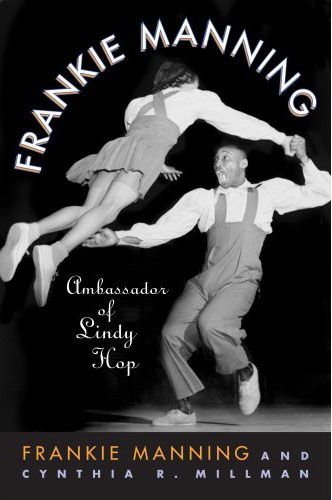
If you like to read more of Frankie Manning's stories, you should buy his new autobiography "Frankie Manning: Ambassador of Lindy Hop".

There is a campaign to make Frankie's book a best seller at Amazon.com. Buy your copy of the book on May 26th.

Do you know more about this video clip? What do you think of this video clip with Frankie Manning's stories? Tell me.

Sunday, May 20, 2007

Lindy hops the Atlantic

Exactly 80 years ago today at May 20th in 1927 Charles Lindbergh started his historic solo flight across the Atlantic ocean from New York to Paris which took 33.5 hours. When he landed some newspaper exclaimed "Lindy hops the Atlantic".

A while after (according to the stories I've heard) there was a reporter visiting a ballroom in New York, and he asked the dancer "Shorty" George Snowden what he was doing. "I'm doing the Lindy hop" Snowden answered. Thus the name of the dance was born.

You can see a replica of Charles Lindberghs plane "Sprit of St. Louis" in Balboa park in San Diego.

Thursday, May 17, 2007

Interview: Cynthia Millman: co-author of "Frankie Manning: Ambassador of Lindy Hop"

Book, autobiography: Frankie Manning: Ambassador of lindy hop

The autobiography by Frankie Manning: Frankie Manning: Ambassador of Lindy Hop has just been released. Cynthia Millman is co-author of the book and I was curious about her so I did an interview with her to find out more about her and the process behind writing the biography.

Can you tell me a little bit about yourself? What do you do for a living? When did you start dancing?

I loved dancing as a kid, but didn’t start training until age 12, after seeing a ballet demonstration. Since then I’ve explored many, many forms of classical, modern, and ethnic dance, but once I discovered swing dancing in the mid 1980s, that was it. I have a master’s degree in dance and dance education, and taught dance (mostly to children) and performed (on and off) for 25 years. Somewhere in there, I made a career shift. I earned a master’s in library science, and have been a children’s librarian for the last fifteen years, currently at The Town School in Manhattan.

When did you first meet Frankie?

I first met Frankie at a dance in 1986, which I describe in the book’s introduction. I didn’t really get to know him until I began performing with the Big Apple Lindy Hoppers in 1990. It was while hearing his stories at dinner after rehearsals that I first realized what an interesting life he had lived, and how gifted he was at describing his experiences.

How would you describe Frankie Manning to someone who doesn’t know him?

Frankie Manning was one of the main creators of the lindy hop at Harlem’s Savoy Ballroom during the 1930s. His choregraphic innovations, especially the air step and synchronized ensemble routines, helped catapult the lindy from ballroom to stage and screen. Frankie’s choreography for and performances as a lead dancer with Whitey’s Lindy Hoppers helped popularize the lindy and disseminate it across America and around the world. With the demise of the Swing Era, Frankie took a “temporary” job in the Post Office . . . and ended up working there for 30 years! His rediscovery by a new generation of swing dancers and his professional comeback were a driving force in the swing dance revival that began in the 1980s and is still going strong. Today, at 93, Frankie has a packed teaching schedule and travels constantly to share with others the joy that swing dancing has brought him. An inspiration to us all, Frankie is as beloved for his marvelous personality as he is for his vital role in American dance history.

Frankie is one of my favorite people in the world, and collaborating on his autobiography was one of the greatest experiences of my life.

How come you started to write the book about Frankie Manning?

In 1987, I interviewed Frankie Manning for an article about the swing dance revival for a small local newspaper in Manhattan. I subsequently interviewed him for a master’s thesis project, an extensive exhibit on the history of swing dancing (which showed at swing dance events in New York City, Herrang, London, and Toronto), and for articles in Dance Magazine and The International Encyclopedia of Dance. In 1993, Frankie and I began doing educational presentations on lindy history that included lecture, interview, demonstration, and video clips. Around this time, I realized that I was completely enchanted by the history of swing dancing and asked Frankie if we could do a book together. Happily, he said yes.

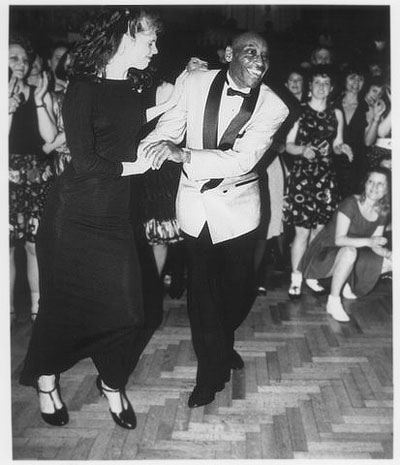
Frankie Manning dancing with Cynthia Millman at CAN'T TOP THE LINDY HOP! during a birthday dance on the occasion of his 80th birthday party in New York City, 1994. Photographer: Timothy Swiecicki.

What is your favorite story from the book?

I love all of Frankie’s stories, but the one that stands out for me is when he danced with Betty Grable at a USO show in New Guinea during World War II. In addition to being a fun story, I feel that it illustrates so much of what Frankie is all about: his ability to make the best of a bad situation with incredible pluck and humor; his use of dance to connect to individuals and audiences; his love of entertaining people and lifting their spirits with his dancing; his professionalism as an entertainer; his respect for musicians; his personal charm; and his ability to disable racial prejudice at a time when it was so deeply entrenched in and so openly a part of American culture.

I also find his story about Sergeant Montgomery very moving. It’s one of the first stories I ever heard Frankie tell, and I’ll never forget hearing it that first time.

Now that the book is done, do you have any other subjects that you would like to write about?

As a children’s librarian, I have quite a few ideas for children’s books. I’m also interested in doing some articles on holistic health practices and meditation. And I’m considering some other research projects in the swing dance area.

Is there anything else you would like to mention?

Just that I hope everyone enjoys reading about Frankie Manning's life. Part of why we were able to get a publisher was because we could demonstrate to Temple University Press that there was an extensive international audience for Frankie’s story. Thinking about sharing the book with all of you helped keep us going during the lengthy process of getting that rich, long life into the pages of a book.


Thank you, Cynthia Millman, for taking time to answer the questions!
Thanks for giving me the opportunity to talk about the book.

Update: Read my book review here.

Order Frankie Manning: Ambassador of Lindy Hop at Amazon.com. Maybe join the campaign to make the book a best seller?

What do you think of this interview? Got other questions for Cynthia Millman? Tell me.

Tuesday, March 13, 2007

Soundies: Jazz and Swing Legends in PBS Documentary

In March a documentary about soundies is shown on the tv channel PBS in USA. Watch the trailer for the soundies documentary.


Soundies were an early version of the music video: three-minute musical films, produced by professional film crews in New York, Chicago, and Hollywood between 1940 and March, 1947. The films were displayed on the Panoram, a coin-operated film jukebox, in nightclubs, bars, restaurants, factory lounges, and amusement centers. [Wikipedia]


The documentary is presented by Michael Feinstein. Here is more information about the program.

It would be interesting to see this program because it gives an insight how melodies was performed in those days, that something you can't get just by listening to recordings. I'm looking forward to see the program sometime.

If you want to learn more about soundies check out "The Soundies Book: A Revised and Expanded Guide" by Scott MacGillivray and Ted Okuda.

Have you seen the soundies documentary? What do you think of it? Tell me.

Monday, February 12, 2007

Frankie Manning: Ambassador of Lindy Hop

Frankie Manning: Ambassador of Lindy Hop is a autobiography about Frankie Manning who is a living legend in the world of lindy hop. This 350 page book will tell about his life and his career and I think it will be an important piece in the history of swing dancing. The book is written together with Cynthia Millman.

The biography will be released in April/May but you can preorder it now if you want to get it as soon as it becomes available.

Update: Read my book review here.

If you don't want to wait that long to read about that era, I recommend that you get the book Swinging At The Savoy The Memoir of a Jazz Dancer by Norma Miller who also danced in the show troupe Whitey's Lindy Hoppers.

Temple University Press lists the contents of "Frankie Manning: Ambassador of Lindy Hop":

Contents
Acknowledgments
Foreword: Mercedes Ellington
Frankie Manning: An Appreciation by Cynthia R. Millman
Prologue: Too Stiff

PART ONE: EARLY STEPS (1914-circa 1933)
Chapter 1. Jazz Baby
Chapter 2. Early Ballroom Forays

PART TWO: SAVOY DANCER (circa 1933-1936)
Chapter 3. To the Savoy at Last
Chapter 4. Whitey, Shorty, and Stretch
Chapter 5. Win Win
Chapter 6. Up in the Air She Goes

PART THREE: WHITEY'S LINDY HOPPERS (1936-1943)
Chapter 7. Going Pro
Chapter 8. Big Time at the Cotton Club
Chapter 9. A Big Apple for Whitey
Chapter 10. On Broadway and In the Movies
Chapter 11. Stranded in Rio

PART FOUR: WAR AND HOME (1943-1984)
Chapter 12. Dancer Interrupted
Chapter 13. The Congaroo Dancers and a Day Job

PART FIVE: SECOND ACT (1984-present)
Chapter 14. Revival

APPENDIXES
A. Frankie Manning Timeline
B. Biographies of Lindy Hoppers
C. List of Works Cited or Consulted
C. Frankie's List of Swing Dance on Film/TV
D. Swing Dance Resources
E. Swing Dance Organizations and Events Index

What are your thoughts about this book? Tell me.

Friday, January 19, 2007

Excerpts from Social Dancing in America


This is the third part of an interview with Ralph G. Giordano who recently published his book Social Dancing in America: A History and Reference Volume 2 Lindy Hop to Hip Hop, 1901-2000.

[Part 1: How come you wrote a book about social dancing in America?]
[Part 2: Which dances do you write about in the book? ]

Part 3: Can you share some interesting facts about Lindy hop?

I can give you some excerpts from the book:

"Most Americans only saw the Lindy Hop in newsreels of the Harvest Moon Ball competitions and movies such as A Day at the Races (1937), Buck Privates (1941), Hellzapoppin’ (1941), Ride ‘Em Cowboy (1942), Groovie Movie (1944) a nine-minute movie short, and Killer Diller (1948). Each provides some of the best acrobatic performance and smooth style versions of the dance ever filmed.

The acrobatic aerial dance movements were eye-catching stellar performances by the best professional Lindy Hop dancers in the country. They were extremely fast paced and choreographed for maximum effect on the movie scene and definitely not for simple enjoyment on a social dance floor."

"The comedy A Day at the Races, starring the Marx Brothers did well at the box office. At the time, the Marx Brothers were one of the top Hollywood box office attractions. Scenes in the movie offer an excellent contemporary singer Alan Jones singing in the "crooning" style made popular by Bing Crosby. In various dance scenes Groucho Marx performs a Tango, Fox Trot, Rhumba, and Charleston.

The film also has an ensemble dance scene between Harpo Marx and some African American children and another scene of African Americans adults performing the Lindy Hop. Unfortunately a large segment of America did not get to see either the Harpo scene or the Lindy Hop scene. Since these scenes involved "racial mixing," they were censored out of distribution copies throughout the south and other areas of the United States. (At that time, this was a common practice of all Hollywood movies).

Copies with deleted scenes continued to air well into the 1970s on television stations. It was not until the very late 20th century that the movie was shown intact. By that time the age of the movie regulated it to specialty cable stations dedicated for movie buffs that regulated the segregation to obscure trivia status."

Wednesday, January 17, 2007

Social dancing in America: List of dances included in the book


This is the second part of an interview with Ralph G. Giordano who recently published his book Social Dancing in America: A History and Reference Volume 2 Lindy Hop to Hip Hop, 1901-2000.

[Part 1: How come you wrote a book about social dancing in America?]

Part 2: Which dances do you write about in the book?


Chapter 1: Animal Dances, The Castles, and Ragtime: 1901–1919
- Cakewalk, 1890 to 1900 (African American)
- Two-Step, 1890 to 1910 (American vernacular)
- Texas Tommy, 1901 to 1905 (African American)
- Ballin’ the Jack, 1901 to 1905 (African American)
- The Slow Drag, 1901 to 1905 (African American)
- Animal Dances: 1910 to 1920 (American vernacular)
Turkey Trot,
Chicken Scratch,
Monkey Glide,
Grizzly Bear,
Bunny Hug.
- Fox Trot, 1910 to 2000 (American vernacular)
- The One-Step, 1910 to 1920 (American vernacular)
- The Castle Walk, 1915 to 1920 (American vernacular)
- Hesitation Waltz, 1910 to 1920 (American vernacular)
- Apaché, 1910 to 1920 (Paris)
- Maxixe 1910 to 1920 (Brazil)
- Argentine Tango, 1905 to 1920 (South America / Caribbean.)
- Tango, 1905 to 1925 (South America / Caribbean.)

Chapter 2: The Charleston, Flappers, and Jazz: 1920 – 1932
- Black Bottom, 1919 to 1927 (African American)
- The Charleston, 1922 to 1929 (American vernacular and African American)
- Fox Trot, 1910 to 2000 (American vernacular)
- Lindy Hop, 1927 to 1945 (American vernacular)
- Rhumba, 1930 to 2000 (Cuba)
- The Quickstep, 1921 to 1929 (American vernacular)
- The Shimmy, 1922 to 1924(African American)
- Varsity Drag, 1927 to 1929 (American vernacular)

Chapter 3: The Lindy Hop, Jitterbug, and Swing: 1932 – 1947
- The Big Apple, 1938 to 1940 (American vernacular and African American)
- Conga, 1938 to 1945 (Brazil and South America)
- Fox Trot, 1910 to 2000 (American vernacular)
- Jitterbug, mid-1930s to 1945 (American vernacular)
- The Lambeth Walk, 1938 to 1940 (Northern Europe)
- Lindy Hop, 1927 to 1945 (American vernacular)
- Rhumba, 1930 to 2000 (Cuba)
- Samba, 1939 to 2000 (Brazil)
- The Shim Sham, mid-1930s to 1945 (American vernacular)


Chapter 4: The Mambo, American Bandstand, and Rock ’n’ Roll: 1947 - 1960
- The Bop, late-1950s (American vernacular)
- The Bunny Hop, 1953 to 1960 (American Vernacular)
- Cha-Cha, 1955 to 2000 (Cuba)
- The Fish, late-1950s (American vernacular)
- The Hand Jive, late-1950s (American vernacular and African American)
- Hokey Pokey, 1947 through 2000 (American vernacular)
- The Madison, late-1950s (American vernacular)
- Mambo, 1954 to mid-1960s (Cuba)
- Merengue, late-1950s to mid-1960s (Dominican Republic)
- Polka, 1947 to mid-1960s (Czech)
- Square Dancing, 1947 through 2000 (European English)
- The Stroll, late-1950s (American vernacular)
- Tarantella, 1947 through 2000 (Italian)

Chapter 5: The Twist, Doing Your Own Thing, and A Go-Go: 1960 – 1969
- Boogaloo, 1966 to 1969. (Afro-Cuban and Puerto Rican)
- Bossa Nova, mid-1960s (South American)
- The Bostella, 1965 to 1966 (Paris, France)
- “Doing Your Own Thing,” 1965 through 2000 (American vernacular)
- The Fish- solo dance, 1961 to 1962, (American vernacular)
- The Freddy, mid-1960s (England)
- The Frug, 1962 to 1968 (American vernacular)
- Go-Go Dancing, 1964 to 1968 (American vernacular)
- Hippie Freestyle, 1965 to 1974 (American vernacular)
- The Jerk, mid-1960s, (American vernacular)
- The Limbo, 1950 through 2000 (Caribbean)
- Mashed Potato, 1961 to 1963 (African American)
- The Monkey, 1963 to 1964 (American vernacular)
- The Pachanga, 1961 to mid-1960s (Cuba and Latin Caribbean)
- Solo Dance Fads, 1961 to 1966
- The Swim, 1964 to 1965 (American vernacular)
- The Twist, 1960 through 2000 (African American)
- The Watusi, 1961 to 1962 (American vernacular)

Chapter 6: The Hustle, Saturday Night Fever, and Disco: 1970 – 1979
- American Hustle, 1975 to 1979 (Latin American)
- The Breakdown, 1974 to 1976 (African American)
- The Bump, 1975 to 1979 (American vernacular)
- The Bus Stop, 1975 to 1979 (American vernacular)
- Disco Line Dances, 1975 to 1979 (American vernacular)
- Disco Freestyle, 1975 through 2000 (American vernacular)
- Latin Hustle, 1975 to 1979 (Latin American)
- The Lock, 1974 to 1976 (African American)
- The Hustle, 1975 to 1979 (Latin American)
- The L. A. Hustle, 1975 to 1979 (Latin American)
- New York Hustle, 1975 to 1979 (Latin American)
- Reggae, 1975 through 2000 (Jamaica)
- Scooby Doo, 1974 to 1976 (African American)
- Shout!, 1978 through 2000 (American vernacular)
- Time Warp, 1977 to late-1980s (England)
- Toga, 1978 through 2000 (American vernacular)
- Y-M-C-A, 1978 through 2000 (American vernacular)

Chapter 7: Breakdancing, Country Dancing, and the Swing Dance Revival: 1980 - 2000
- Breakdancing, 1970 to mid-1980s (African American)
- Country Line Dancing, 1990 to 2000 (American vernacular)
- Country Dancing, 1980 through 2000 (American vernacular)
- East Coast Swing, 1990 through 2000 (American vernacular)
- The Electric Slide, 1989 through 2000 (American vernacular)
- Hip-hop, late-1980s through 2000 (African American)
- “House Music,” mid-1980s through 2000 (American vernacular)
- Krumping, late-1990s through 2000 (African American)
- Lindy Hop Revival, mid-1980s through 2000
- The Lambada, 1988 to 1991 (Brazil)
- Macarena, 1993 to 2000 (Spain and South America)
- Moonwalk, 1983 to 1990 (African American)
- Rave, mid-1980s through 2000 (Urban American),
- Salsa, 1980 through 2000 (Latin American and Caribbean)
- Square Dancing, 1947 through 2000 (American vernacular)
- Swing Revival, 1992 through 2000 (Urban American),
- Shag, 1947 through 2000 (American vernacular)
- Slam Dancing, 1980 to mid- 1990s, (England and Urban American),
- Two Step, 1980 through 2000 (American vernacular)
- Vogueing, 1990 to 1995 (Urban American),
- West Coast Swing, mid-1950s through 2000 (American vernacular)


Tuesday, January 16, 2007

Interview with Ralph Giordano, author of the book Social Dancing in America


This is the first part of an interview with Ralph G. Giordano who recently published his book Social Dancing in America: A History and Reference Volume 2 Lindy Hop to Hip Hop, 1901-2000.


Part 1: How come you wrote a book about social dancing?
[Part 2: Which dances do you write about in the book?]

I teach part-time at the City University of New York and have been writing for historical journals and the thought of combining an historical/cultural work with my own love of social dancing was intriguing.
I definitely wanted to write a scholarly contribution to the very much overlooked American cultural development of Social dancing, however, I wanted to present it in a writing style that would appeal to the average individual. I have discovered in my time within dance clubs, especially the swing dances, that many individuals enjoy dressing in period costume and are quite interested in the history of their favored dance style.


My wife and I have danced in over 23 states in America and six other countries, and visited hundreds of dance clubs, probably a thousand or more if you include outdoor dance events. A very good tool that I learned from architecture is the empirical study of the movement of people when they do not know that they are being observed. In that same sense I was obviously heavily involved in actually dancing or learning a dance style. In the kinetic motion of dancing it is extremely important to just try and move with the music. In that same end it was extremely important being within the social dance environment and also visiting the Cecil Sharp House in London as well as taking a series of classes in English Country-dancing. My wife and I attended and it became an invaluable aid when I was researching the written description of the 18th century dances that I fully understood them because of our time actually performing the steps.

So as it turns out, to date this is the first book of its kind that has put together both a general interest reader and a scholarly work that discusses social dancing in a complete social, cultural, economic, political, and historical context. Many social dance books of the period simply provided descriptions and step-by-step instructions on “how to dance” as opposed to why people dance. My book also provides a consistent theme that contemporary dances and the associated music and fashion were more often attacked by forces of social morality and often labeled the newest dance trend as “scandalous.”

This book is not a book to teach people “How to Dance” there are literally thousands of publications and hundreds of dance studios available to do just that. This book is an attempt to provide a clear understanding of what was involved in the basic patterns and rhythms of the dance, the origins, the popularity, but most importantly to place each in a historical and social context. This book is about the dances themselves and their importance in a social context. Therefore, each chapter contains a brief introduction of the social, political, and cultural climate. The book is about how individual Americans; mainly couples interacted in a social dance setting.


Monday, January 15, 2007

What kind of jazz? Jazz history at Verve

Sometimes people ask me: "Do you like jazz?". "Of course I do", I answer. But then I wonder, "What kind of jazz you mean?" Because there are so many styles of jazz they could be talking about: New Orleans, swing, bebop, latin, cool, fusion, hard bop, avant garde, vocal jazz and many other jazz styles.

The jazz label Verve has descriptions of the history of different jazz styles.

I like swing music best, of course.

Do you know any other good web sites about jazz styles? Let me know.

Sunday, January 14, 2007

Social Dancing in America: A History and Reference Volume 2 Lindy Hop to Hip Hop

A new interesting book about dancing and lindy hop by Ralph G. Giordano has been published: Social Dancing in America: A History and Reference Volume 2 Lindy Hop to Hip Hop, 1901-2000 .
From the book description:

"relates the history of the most popular social dances, where they began, which dances survived the test of time and why, and what attracted American men and women to social dancing in these periods. Unlike other books on social dancing that taught people "How to Dance," this books not only describes the dances, but also WHY Americans danced."


Have you read this book? Please tell me what you think of it.